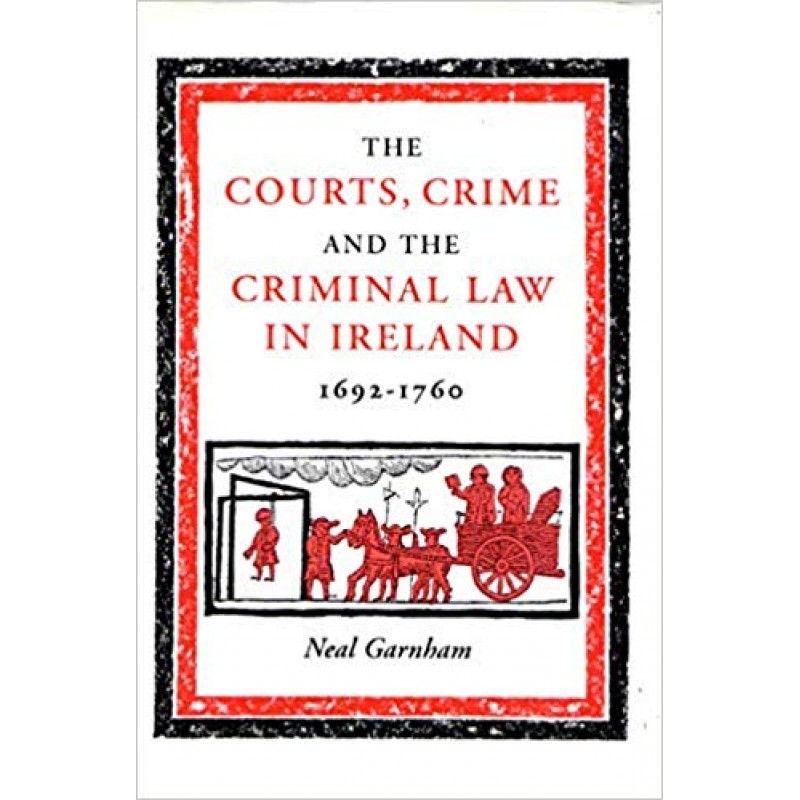
The Courts, Crime and the Criminal Law in Ireland, 1692-1760.
€19.99
A major scholarly study of criminal justice in 18th-century Ireland, this book by Neal Garnham examines how courts, policing, and criminal law operated between 1692 and 1760, covering judges, magistrates, trials, and patterns of crime across Irish society.
The Courts, Crime and the Criminal Law in Ireland, 1692–1760 by Neal Garnham is a detailed legal and social history published by Irish Academic Press in 1996. The work provides one of the most comprehensive analyses of how the Irish criminal justice system functioned in the early modern period, focusing on both institutional structures and everyday enforcement of law.
The book examines the full process of criminal justice in Ireland during the eighteenth century, including how crimes were detected, prosecuted, and punished. It studies the roles of courts, judges, magistrates, juries, and local officials such as constables, offering a full picture of how law operated outside Dublin as well as in urban centres.
Rather than focusing only on major political crimes, Garnham explores a wide spectrum of offences, including theft, assault, rape, murder, riots, and petty crime. He also investigates how legal institutions interacted with ordinary communities and how justice was experienced at local level.
Key themes include:
Structure of Irish courts and legal administration (1692–1760)
Role of judges, magistrates, and juries in criminal trials
Policing and local enforcement through constables and officials
Common crime patterns: theft, assault, murder, and riot
Functioning of assize courts and regional justice systems
Relationship between law, society, and authority in Ireland
Operation of criminal law under the Protestant Ascendancy
Access to justice and limitations of enforcement in rural Ireland
A central argument of the book is that criminal justice in eighteenth-century Ireland was not a fully centralised system but rather a decentralised network of local authorities, heavily dependent on landowners and magistrates. This created uneven enforcement of law, especially in rural areas where official presence was limited.
The study also highlights how social order was maintained not only through formal law but also through informal community mechanisms, reflecting the realities of a society where state authority was often thinly spread outside major towns.
Drawing on court records, legal documents, and administrative archives, Garnham reconstructs how law functioned in practice rather than in theory. The result is a nuanced portrait of Irish society where crime, governance, and social hierarchy were deeply interconnected.
This work is widely regarded as an essential reference in Irish legal history, early modern studies, and criminology, and is frequently cited in scholarship on the development of the Irish justice system.
Additional information
Weight
0.5 kg
Reviews
There are no reviews yet.
Only logged in customers who have purchased this product may leave a review.









Reviews
There are no reviews yet.