Description
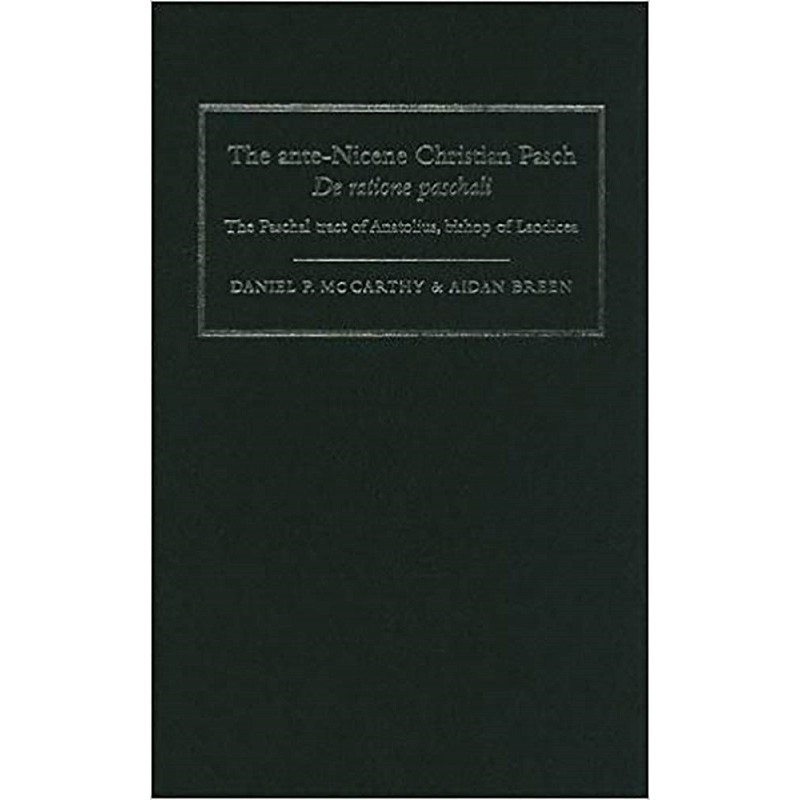
The Ante-Nicene Christian Pasch: De Ratione Paschali is a scholarly edition published by Four Courts Press in 2003, edited and translated by Daniel P. McCarthy (Trinity College Dublin) and Aidan Breen. It presents the first modern critical reconstruction and interpretation of the Latin text known as De Ratione Paschali, a complex early Christian treatise dealing with the calculation of the Paschal (Easter) feast.
The work is traditionally attributed to Anatolius of Laodicea, a 3rd-century bishop and one of the earliest known Christian computists (calendar scientists). He is associated with the development of early 19-year lunar cycles used to calculate the date of Easter in relation to the Jewish Passover and the Julian calendar.
McCarthy and Breen’s edition provides:
- A critical Latin text reconstructed from multiple medieval manuscripts
- An English translation of De Ratione Paschali
- Extensive commentary on Paschal computation systems
- Analysis of astronomical and mathematical structures in the text
- Discussion of manuscript transmission and textual history
The book demonstrates that early Christian debates over Easter were not only theological but also deeply connected to astronomy, arithmetic cycles, and calendar science.
A key focus is Anatolius’ sophisticated system of calculating Easter, which includes:
- A structured 19-year lunar cycle (Metonic cycle adaptation)
- Rules governing the Paschal full moon (luna 14–20)
- The relationship between solar equinox (March 22–25 range) and liturgical timing
- Early attempts to standardise Christian festal calendars
The editors also engage with scholarly debate over whether the text is genuinely 3rd-century Syrian in origin or a later Irish or medieval composition attributed to Anatolius, a question that has shaped modern research into early Christian chronology.
Key Themes
- Early Christian computation of Easter (computus paschalis)
- Pre-Nicene church calendar traditions
- Anatolius of Laodicea and early scientific theology
- Lunar cycles and astronomical calculation in antiquity
- Relationship between Passover and Christian Pascha
- Manuscript tradition and textual criticism
- History of mathematics in early Christian scholarship
- Development of the 19-year lunar cycle
Only logged in customers who have purchased this product may leave a review.










Reviews
There are no reviews yet.