Description
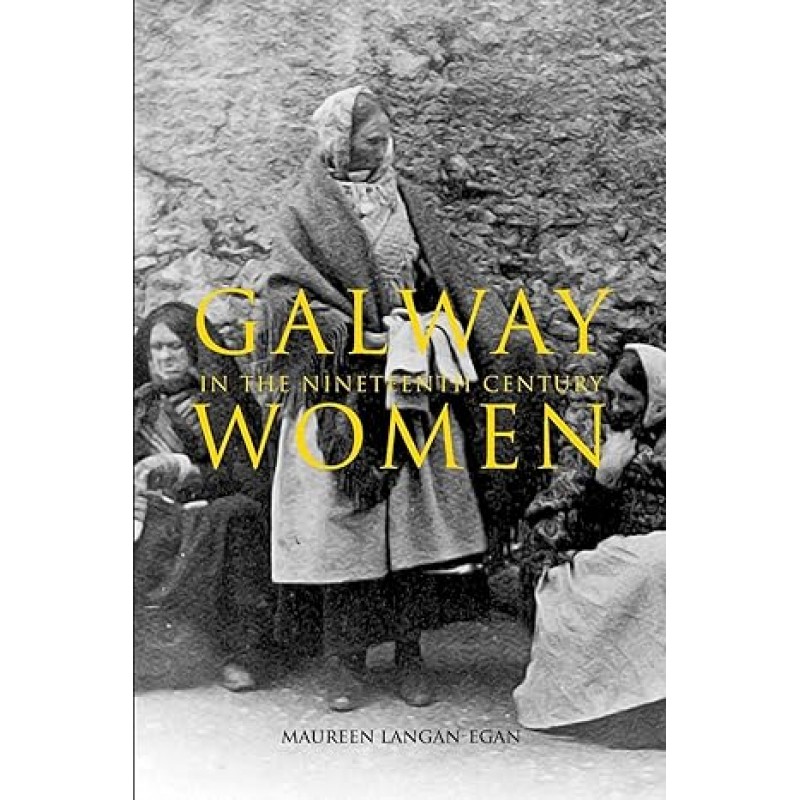
This book delineates the lives of the ‘Unknown Irishwoman’ in a turbulent century in Galway County and City on Ireland’s western seaboard. Their (Irishwomen’) lot in history cannot easily be measured. Much of it has disappeared; more of it was never recorded (Bowman, 2014). The work tells many of the untold or forgotten stories of ‘the lives of women which slide between the cracks’, to cite the novelist Martina Devlin (2014) and who could so easily be completely written out of history.
The book will appeal to the local historian, those with an interest in social history, women’s history and the general reader. The book is organised into three main sections, each of which has a number of chapters. They are The Necessities of Life, The Nature of Society and Distress, followed by an Epilogue and Addenda. The Necessities of Life include chapters on Employment, Housing, Clothing and Food ‘always the major source of anxiety for the labourer of Ireland’ (O’Neill, 1984). The Nature of Society deals with Marriage, Unmarried Mothers, Religion and Education. The double standards regarding sexual behaviour which pervaded society at the time are clearly shown. The section on Distress contains chapters on Distress and Famine, Migration and Emigration, Women and Crime. The different sentencing patterns in courts for both men and women are of interest.
The Epilogue depicts reveals how women came to be more disadvantaged than in the earlier part of the century. The subservient role of women in Irish society was further emphasised when a new definition of work ‘from being all work contributing to the operation of society to a narrower definition based on the idea of economic activity’ introduced in the 1861 Census meant that many women became invisible, from an official point of view. From that point on, women’s non-wage labour counted for nought in official records. This further lowered women’s status in society.
Only logged in customers who have purchased this product may leave a review.








Reviews
There are no reviews yet.