

Description
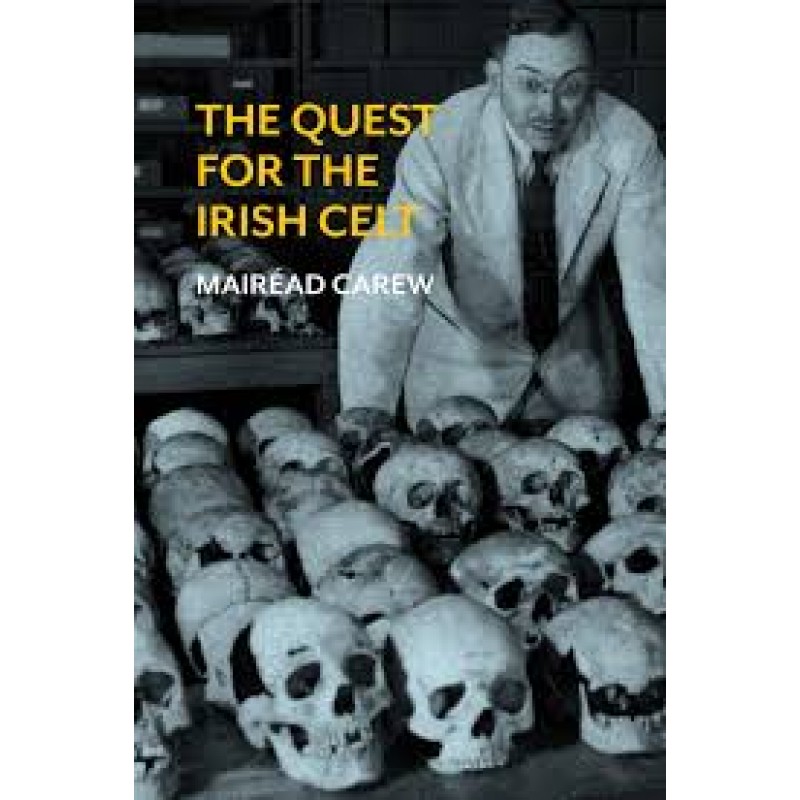
The Quest for the Irish Celt: The Harvard Archaeological Mission to Ireland, 1932–1936 by Mairéad Carew is a compelling study of one of the most ambitious and controversial archaeological research programmes ever undertaken in Ireland. Published by Irish Academic Press, the book examines Harvard University’s five-year mission to investigate the origins and racial identity of the Irish people through archaeology, physical anthropology, and ethnographic research.
Beginning in 1932, the Harvard Mission brought together archaeologists, anthropologists, and social scientists to excavate archaeological sites across Ireland, analyse prehistoric human remains, and carry out physical examinations of thousands of Irish people. Their aim was to identify the origins of the so-called “Irish Celt” and determine how modern Irish people were connected to Ireland’s earliest inhabitants. Today, many of the project’s methods and assumptions—particularly its reliance on racial classification and eugenic theory—are recognised as scientifically flawed and ethically unacceptable, making the story both historically significant and deeply thought-provoking.
The book explores a wide range of topics, including:
- The origins and objectives of the Harvard Archaeological Mission
- Major archaeological excavations carried out between 1932 and 1936
- The influence of archaeology on Irish national identity
- The role of physical anthropology and racial classification
- The relationship between archaeology, politics, and the Irish Free State
- The involvement of Earnest A. Hooton, Harvard’s leading anthropologist
- The influence of Adolf Mahr, Director of the National Museum of Ireland and a member of the Nazi Party
- The lasting impact of the project on Irish archaeology and heritage studies
Drawing extensively on archival material from Harvard University, the National Museum of Ireland, and Irish government records, Carew reconstructs the intellectual, political, and cultural environment in which the project took place. She demonstrates how archaeology became intertwined with questions of nationalism, identity, and state-building in the early decades of the Irish Free State while also revealing the influence of contemporary international ideas about race and eugenics.
The author also highlights the positive legacy of the Harvard Mission. Its excavations helped professionalise Irish archaeology, introduced modern excavation techniques, expanded archaeological training, and inspired a new generation of Irish archaeologists. At the same time, the book critically examines the ideological assumptions that underpinned the project, offering an important reassessment of how archaeology has been used to construct narratives of national identity.
Beautifully illustrated and supported by extensive notes, maps, and archival photographs, The Quest for the Irish Celt combines scholarly research with accessible writing, making it valuable for both specialists and general readers. It provides a fascinating account of the intersection between archaeology, science, politics, and identity during a transformative period in Irish history.
Ideal for readers interested in Irish archaeology, twentieth-century history, anthropology, heritage studies, archaeology of nationalism, and the history of science, The Quest for the Irish Celt is an insightful and authoritative examination of a landmark chapter in Ireland’s archaeological past.




Reviews
There are no reviews yet.