Description
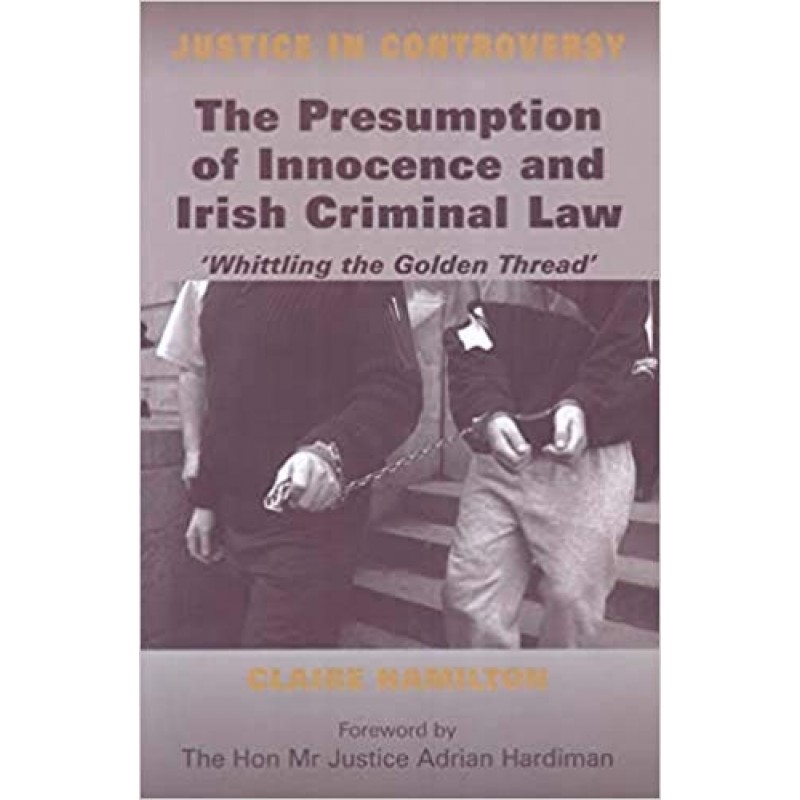
The Presumption of Innocence and Irish Criminal Law: Whittling the ‘Golden Thread’ by Claire Hamilton is a thought-provoking legal study that examines the evolution of one of the cornerstones of Irish criminal justice—the presumption that every person is innocent until proven guilty. Published by Irish Academic Press as part of its Justice in Controversy series, the book offers a detailed analysis of whether this long-established constitutional safeguard has been eroded by modern criminal justice reforms.
The presumption of innocence has traditionally been described as the “golden thread” running through the criminal law, requiring the prosecution to prove guilt beyond reasonable doubt. Drawing on Irish constitutional law, common law traditions, and international human rights principles, Hamilton investigates whether this principle remains fully effective in practice or has become increasingly limited through legislative and judicial developments.
A significant focus of the book is the wave of criminal justice reforms introduced in Ireland following the murder of journalist Veronica Guerin in 1996. These measures, designed to combat organised crime and drug trafficking, prompted major changes to Irish criminal procedure and raised important questions about the balance between protecting society and safeguarding individual rights. Hamilton critically evaluates how these reforms have affected the traditional presumption of innocence.
The book explores a wide range of topics, including:
- The constitutional foundations of the presumption of innocence in Irish law
- Judicial exceptions to the principle
- The burden and standard of proof in criminal proceedings
- The right to silence and its limitations
- Bail law and preventative detention
- Civil forfeiture and the seizure of criminal assets
- Police powers and investigative procedures
- The rights of remand prisoners
- Comparisons with international human rights standards and other legal systems
Hamilton argues that while the presumption of innocence remains a recognised constitutional principle, a series of legislative innovations—including expanded police powers, restrictions on the right to silence, reverse evidential burdens, and proceeds-of-crime legislation—have increasingly qualified its practical application. The book carefully considers whether these developments represent necessary responses to serious crime or an erosion of one of the most important protections in criminal law.
Written in a clear and accessible style, the volume combines legal analysis with discussion of important Irish court decisions, constitutional principles, and European human rights jurisprudence. It provides readers with a thorough understanding of how criminal justice policy has evolved in Ireland and the continuing debate over the balance between public safety and individual liberties.
Containing extensive references, case law analysis, and a comprehensive index, The Presumption of Innocence and Irish Criminal Law has become an important reference for lawyers, academics, students, and policymakers interested in Irish criminal justice and constitutional rights.
Ideal for readers interested in Irish criminal law, constitutional law, legal history, human rights, criminology, and criminal justice policy, this authoritative work provides a critical examination of one of the most fundamental principles underpinning the Irish legal system.
Only logged in customers who have purchased this product may leave a review.








Reviews
There are no reviews yet.