
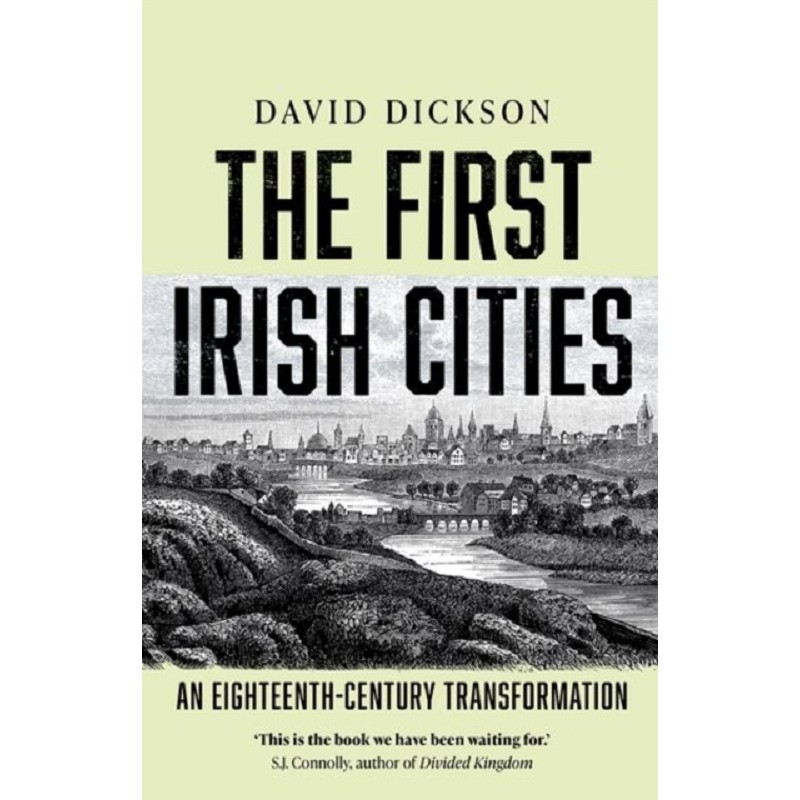

Description
The First Irish Cities: An Eighteenth-Century Transformation by David Dickson is a landmark work of Irish urban history published by Yale University Press in 2021. It offers the first comprehensive comparative study of Ireland’s leading cities during the long eighteenth century, tracing their evolution from early modern fortified towns into dynamic centres of trade, administration, and cultural life.
The book examines ten major urban centres—Dublin, Cork, Belfast, Limerick, Waterford, Galway, Drogheda, Kilkenny, Sligo, and Derry—and explains how each developed distinct but interconnected roles within Ireland’s emerging urban network. It highlights the forces that shaped urban expansion, including trade, migration, governance, and the legacy of political conflict.
Dickson shows that Ireland’s cities experienced remarkable growth between the late seventeenth and early nineteenth centuries, driven by increasing trade links, population movement from rural areas, and Ireland’s integration into wider Atlantic and British economic systems. Dublin emerges as a dominant metropolitan centre, functioning as an administrative, cultural, and commercial capital with influence far beyond other Irish towns.
Key themes include:
- Rapid urban growth in eighteenth-century Ireland
- Development of Dublin as a political and cultural capital
- Expansion of port cities such as Cork, Belfast, and Waterford
- Migration, labour markets, and urban population change
- Trade networks and Atlantic commerce
- Social inequality, poverty, and urban living conditions
- Religion, politics, and civic unrest in Irish towns
- Comparative urban development across Irish regions
The book also explores how Irish towns were shaped by both “hard improvement” (physical rebuilding, infrastructure, and planning) and “soft improvement” (education, print culture, civic societies, and intellectual life). These developments reflect Ireland’s increasing urban sophistication during the eighteenth century.
A major contribution of the work is its comparative approach, allowing readers to see how different cities followed distinct development paths while still sharing common structural forces. It also highlights how Irish urbanisation was unusually strong for a European region often characterised as rural, challenging older assumptions about Ireland’s economic and social history.
Richly researched and supported by statistical analysis, historical records, and comparative urban theory, The First Irish Cities is widely regarded as a definitive modern study of Ireland’s urban transformation before industrialisation.

Reviews
There are no reviews yet.