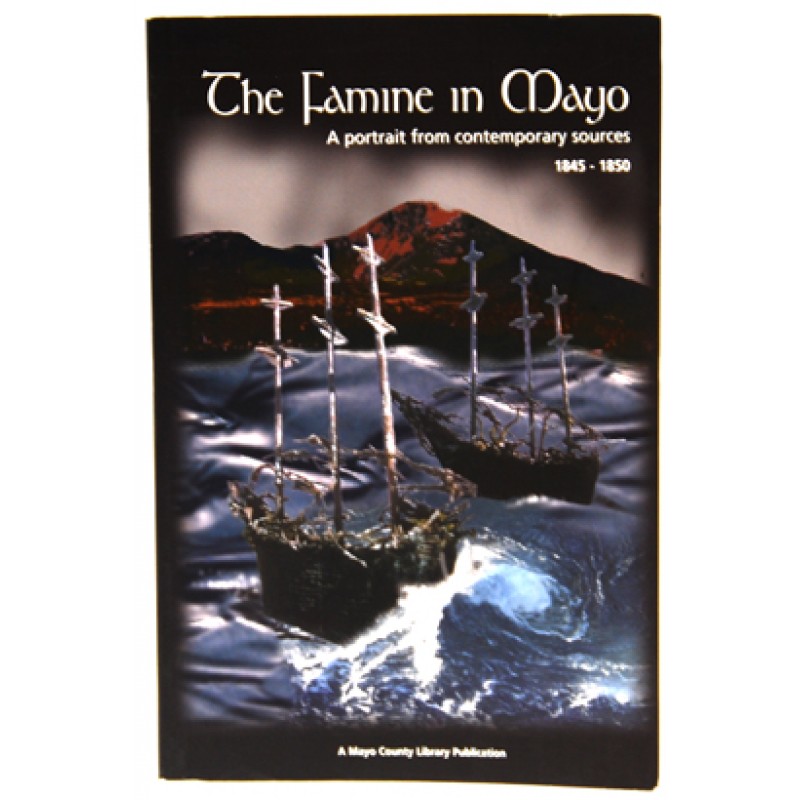
The Famine in Mayo – A Portrait from contemporary sources 1845 – 1850
€15.00
A documentary history of the Great Irish Famine in County Mayo, this work by Ivor Hamrock compiles eyewitness accounts, newspapers, official reports, and archival records to present a direct, source-based record of famine life between 1845 and 1850. It focuses on evictions, starvation, relief efforts, and emigration during one of the most devastating periods in Irish history.
The Famine in Mayo: A Portrait from Contemporary Sources, 1845–1850 by Ivor Hamrock is a documentary collection published by Mayo County Council that reconstructs the impact of the Great Famine through original contemporary material rather than later historical interpretation.
The book draws extensively on newspapers, official government reports, eyewitness testimonies, relief records, and local correspondence to build a detailed picture of how the famine unfolded in County Mayo—one of the worst-affected regions in Ireland.
Covering the years 1845–1850, the work presents material as it originally appeared, preserving the language, tone, and spelling of the time. It includes accounts of widespread hardship across towns, villages, and rural townlands, showing how famine conditions varied locally but consistently resulted in hunger, displacement, and death.
Key themes include:
The outbreak and spread of potato blight in Mayo
Mass evictions and destruction of rural housing
Workhouses, relief schemes, and government response
Eyewitness accounts of starvation and disease
Emigration and population collapse
Role of landlords, agents, and local authorities
Social breakdown and community survival strategies
Daily life during famine conditions in rural Ireland
A major strength of the book is its primary-source approach, allowing readers to experience the famine through the voices of those who lived through it. This method provides a raw and often stark portrayal of suffering, while also documenting administrative responses and public commentary from the period.
Rather than offering a single narrative interpretation, the compilation allows contrasting perspectives to emerge, revealing tensions between official reports and lived experience. It also highlights how famine conditions were recorded and reported differently across newspapers, government documents, and local accounts.
The result is both a historical archive and a regional study, making it a valuable resource for understanding how the Great Famine affected County Mayo specifically—one of the counties with the highest mortality and emigration rates.
This work is widely used in Irish local history research, famine studies, genealogy, and archival studies, providing an essential reference for understanding the human and administrative dimensions of the Irish Famine at ground level.
Additional information
Weight
0.5 kg
Reviews
There are no reviews yet.
Only logged in customers who have purchased this product may leave a review.



Reviews
There are no reviews yet.