Description
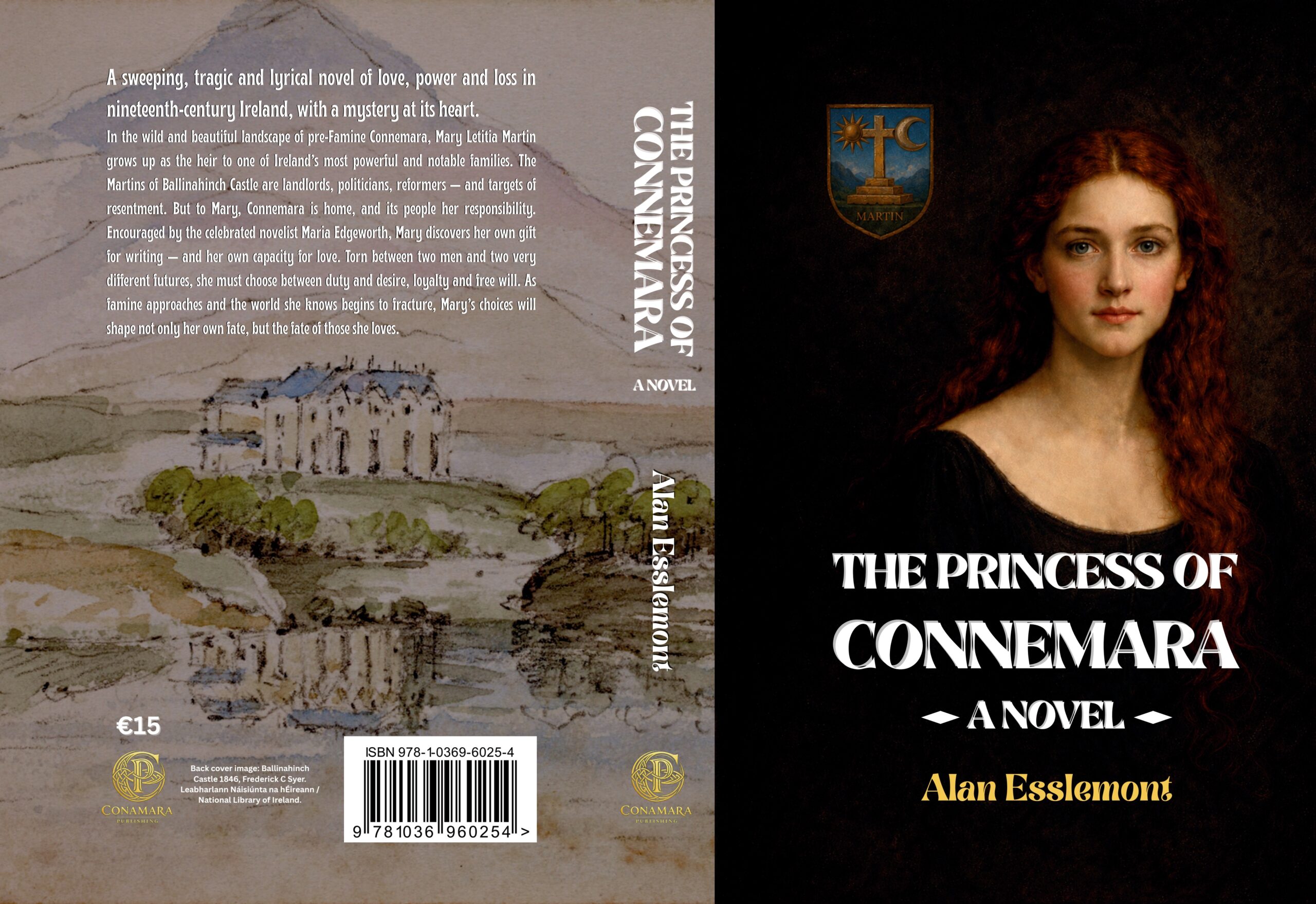
Encouraged by the celebrated novelist Maria Edgeworth, Mary discovers her own gift for writing — and her own capacity for love. Torn between two men and two very different futures, she must choose between duty and desire, loyalty and free will.
As famine approaches and the world she knows begins to fracture, Mary’s choices will shape not only her own fate, but the fate of those she loves.”
BACKGROUND TO THE NOVEL
Ballynahinch Castle Hotel in Connemara has the well-earned reputation of being one of Ireland’s finest hotels. The building was founded in 1756 and ‘Ballinahinch Castle’, as it was then known, became the seat of Galway’s Martin family from the 1790s. The townland of Ballynahinch, Baile na hInse, has been described by the cartographer and author, Tim Robinson, as ‘the historic kernel of Connemara’.
‘The Princess of Connemara – A Novel’ sees the departure of the divorced and heavily indebted Richard Martin from Dangan in Galway and his arrival in Ballynahinch with his three children, Laetitia, Tom and St George. Richard Martin had earned the sobriquet ‘Hair-trigger Dick’ in his younger duelling days, and later ‘Humanity Martin’ as an MP who campaigned in the UK Parliament against cruelty to animals. His move to Westminster after the Act of Union 1801, and the astonishment in London society about the huge size of his landholding in Ireland, brought Richard a new appellation – ‘The King of Connemara’.
The core of the novel centres on Richard Martin’s granddaughter, Mary Letitia Martin, who was born in Connemara in 1815. From Maria Edgeworth’s description of Mary in 1833, it is evident that Mary Martin was a remarkable woman. “I began to study Mary and found her really one of the most extraordinary persons I ever saw… “
Debut author, Alan Esslemont, is well known as a television executive in media circles in both Ireland and Scotland. His novel draws on extensive research begun in 2004, including historical records, letters, Mary Martin’s own writings, and contemporary accounts, to imagine her inner life, her relationships, her world and the world of Connemara before it was transformed forever by the Great Famine.
Reflecting on the inspiration behind the novel, Esslemont said: “I was always surprised that so little attention had been given to this fascinating and complex woman, Mary Martin, author, polymath, polyglot, benefactor, born and brought up in the far west of pre-Famine Ireland. I hope this story brings to life a vanished world, celebrates the gifted woman who was Connemara’s first published novelist, and shines some light on the mystery which surrounds her. She deserves to be remembered.”
About the Author:
Alan Esslemont was born in Braemar, Scotland, in 1958. He moved to Ireland in 1984 to teach at the University of Galway and has lived in Connemara since 1985.
Much of his career has been in television, where he played a central role in Irish-language broadcasting. He was a member of the senior management team that launched TG4, Ireland’s Irish-language television service. As TG4’s first Head of Content, he was also instrumental in the successful launch of BBC ALBA, the Scots Gaelic television channel, in 2008.
In 2016, he was appointed Director General of TG4. During his tenure, he initiated a dedicated children’s service, Cúla4, and established Cine4, an Irish-language cinema brand that contributed to the Oscar nomination in 2023 of An Cailín Ciúin (The Quiet Girl).
In November 2023, the University of Galway awarded him an honorary Doctorate of Literature (D.Litt) in recognition of his contribution to Irish-language media and cinema. He received a Lifetime Achievement Award from Oireachtas na Gaeilge in 2024, followed by the Royal Television Society Ireland Award for Outstanding Achievement in 2025. He retired as Director General of TG4 in April 2025. In May 2026, Comhaltas Ceoltóirí Éireann announced Alan as a recipient of a ‘Gradam 75’ award in recognition of his outstanding contribution to Irish culture.