
Description
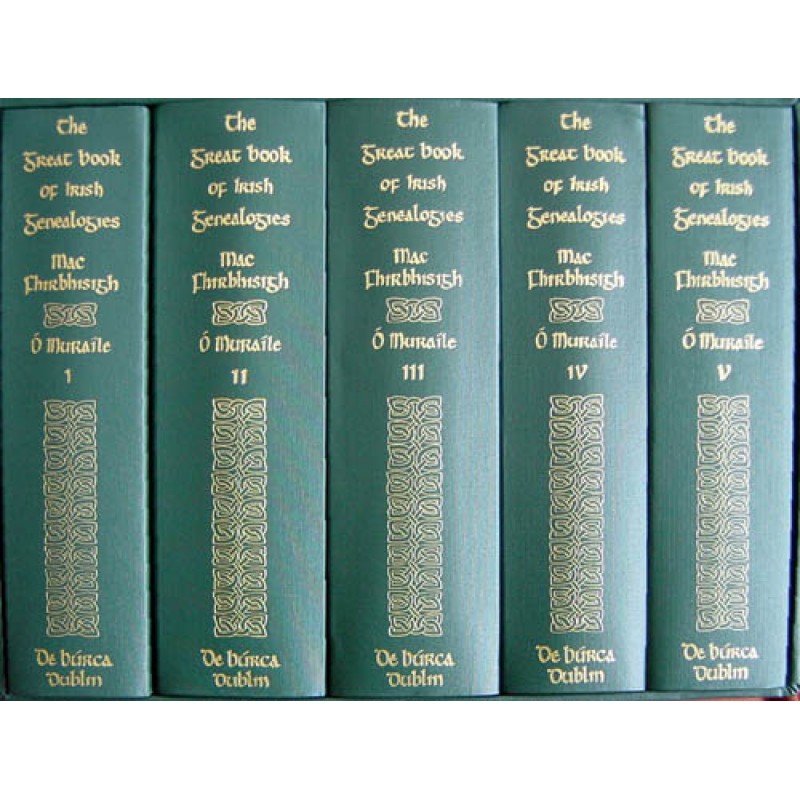
The Great Book of Irish Genealogies is the modern critical edition of Dubhaltach Mac Fhirbhisigh’s 17th-century manuscript Leabhar na nGenealach, one of the most significant surviving sources for early Irish history and genealogy. Edited, translated, and extensively annotated by Dr. Nollaig Ó Muraíle, the work was published in a five-volume scholarly set by De Búrca Books in 2003–2004.
Mac Fhirbhisigh, a member of a learned Gaelic family from Connacht, compiled the original manuscript between 1645 and 1666 during a turbulent period in Irish history marked by war, land confiscation, and the collapse of the Gaelic order. His work systematically records the genealogies of Irish ruling families, noble lineages, saints, and mythological ancestors.
The modern edition by Ó Muraíle makes this vast and complex manuscript accessible through translation, commentary, and indexing, preserving both the original Irish text and its historical context.
This work is considered one of the most important references in Irish historical studies, comparable in importance to the Annals of the Four Masters. It documents:
- Gaelic Irish dynasties and kingships
- Lineages of major families such as O’Neill, O’Connor, O’Donnell, Burke, and Fitzgerald
- Connections between Irish and Scottish Gaelic nobility
- Mythological and semi-historical ancestral traditions
- Saints and ecclesiastical genealogies
- Norman, Viking, and Gaelic interactions
- Political geography of pre-17th century Ireland
- Transmission of oral tradition into written genealogical record
The edition is structured across five volumes:
- Volume I: Early peoples, Gaels, Uí Néill, Connacht genealogies
- Volume II: Ulster, Leinster, Munster, saints, Gaelic Scotland
- Volume III: Kings, Vikings, Normans, genealogical poems
- Volume IV: General reference and commentary
- Volume V: Comprehensive index of personal names
Beyond its genealogical importance, the work is also a key source for understanding how medieval Irish society viewed identity, inheritance, kingship, and historical legitimacy. It reflects a worldview where lineage defined political authority, land rights, and social structure.
Today, The Great Book of Irish Genealogies is essential for Irish genealogy research, medieval studies, Celtic studies, and historical linguistics, and remains one of the most extensive published genealogical compilations in Europe.



Reviews
There are no reviews yet.